The short version
- A reading has two numbers: the top (systolic) and the bottom (diastolic).
- Normal for adults is under 120 on top and under 80 on the bottom.
- High blood pressure starts at 130 on top or 80 on the bottom.
- Your average over many days matters more than any one reading.
- If a reading is higher than 180/120, check again and know when to call 911.
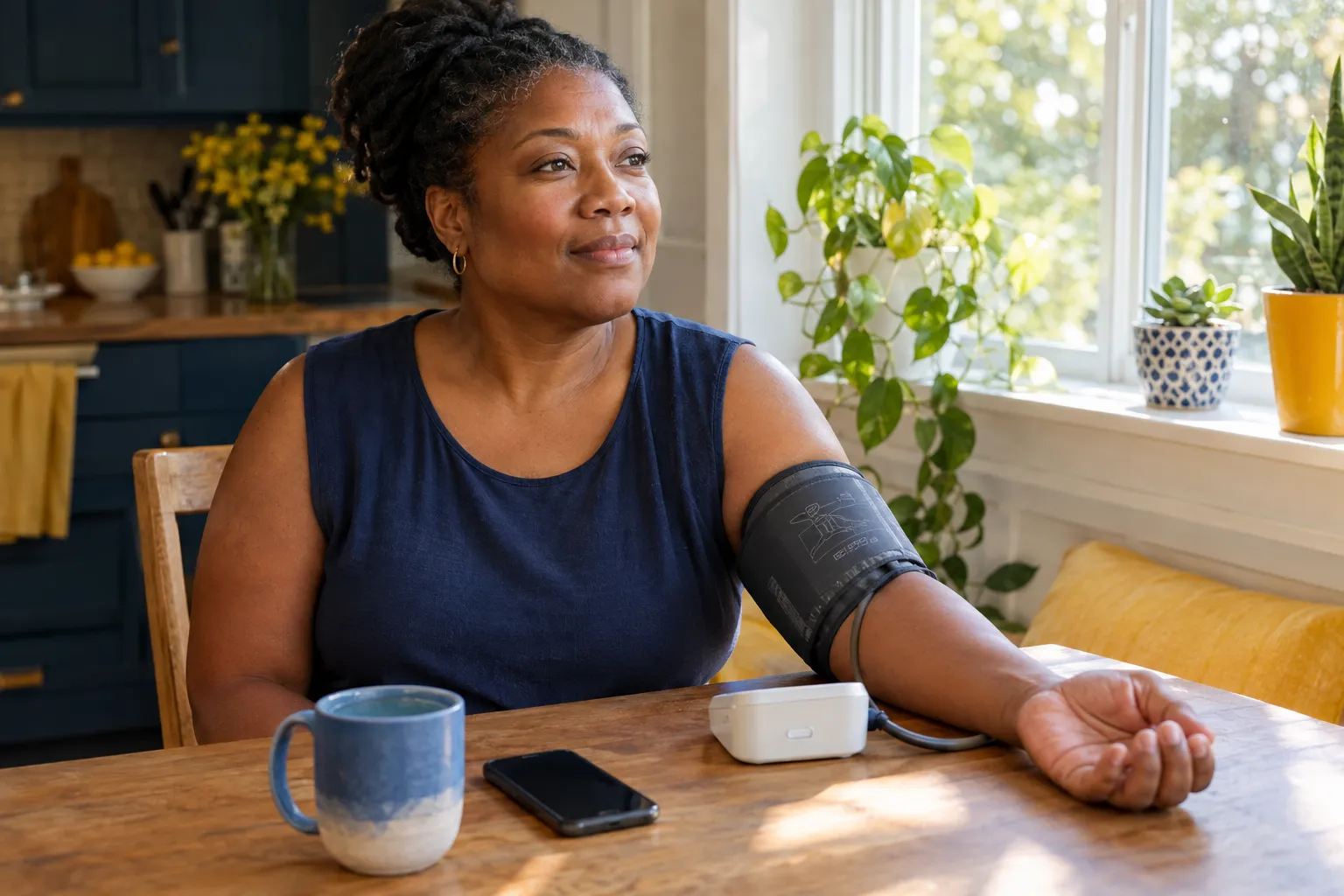
What do your blood pressure numbers mean?
A blood pressure reading has two numbers, like 124/78. You say it "124 over 78." The top number (systolic) is the pressure in your arteries when your heart beats. The bottom number (diastolic) is the pressure when your heart rests between beats (AHA). Both are measured in mm Hg, short for millimeters of mercury.
For adults, normal is a top number under 120 and a bottom number under 80. High blood pressure starts at 130 on top or 80 on the bottom (2025 AHA/ACC guideline). If your two numbers land in different groups, the higher group is the one that counts (2025 AHA/ACC guideline).
One reading is a snapshot. Your care team looks at your average over time, not one number on one day.
Start here
- Blood pressure basics: what the two numbers mean: for anyone who wants the plain basics of the top and bottom numbers.
- How to take an accurate blood pressure reading at home: for anyone with a home cuff who wants numbers they can trust.
- The best times to check your blood pressure: for building a simple morning and evening routine.
- When to call 911 about high blood pressure: for knowing which numbers and signs mean you need help now.
What are the blood pressure categories?
The American Heart Association uses these groups for adults, based on the 2025 guideline (AHA; 2025 AHA/ACC guideline).
| Category | Top number | Bottom number | |
|---|---|---|---|
| Normal | Less than 120 | and | Less than 80 |
| Elevated | 120 to 129 | and | Less than 80 |
| Stage 1 high blood pressure | 130 to 139 | or | 80 to 89 |
| Stage 2 high blood pressure | 140 or higher | or | 90 or higher |
| Severe high blood pressure | Higher than 180 | and/or | Higher than 120 |
Look at the small words in the middle. "And" means both numbers must fit. "Or" means only one has to. So 128/84 is stage 1, because the bottom number is in the stage 1 range.
Only a doctor, nurse practitioner, or other clinician can tell you if you have high blood pressure (AHA). This chart helps you understand a reading. It is not a diagnosis.
Which number matters more?
Both matter. A high top number or a high bottom number can be used to diagnose high blood pressure. For people over 50, the top number says more about heart disease risk. That is because arteries get stiffer with age, so the top number tends to rise (AHA).
Why isn't one reading the whole story?
Your blood pressure goes up and down all day. Stress, pain, cold, coffee, a full bladder, or rushing can push one reading up. That does not always mean something is wrong.
This is why the guideline says to diagnose high blood pressure from an average of 2 or more careful readings, taken on 2 or more different days (2025 AHA/ACC guideline). A pattern tells your care team much more than any single number.
Why is my number higher at the doctor's office?
Some people have higher readings in the clinic than at home. This is called white coat hypertension. Other people have the opposite: normal numbers at the clinic but high numbers at home. This is called masked hypertension. Home readings can help your care team spot both (2025 AHA/ACC guideline).
How do home readings help?
The American Heart Association suggests home checks for everyone with high blood pressure. Home readings show your care team if treatment is working, and can help confirm a diagnosis (AHA).
Good home numbers come from good habits. The basics are simple (AHA):
- Use an automatic cuff that goes on your upper arm. Wrist and finger monitors are less reliable.
- Sit quietly for 5 minutes with your back supported, feet flat, and arm at heart level.
- Take two readings, one minute apart, and write down both.
- Check at about the same time each day.
For the full step-by-step checklist, see how to take an accurate reading at home. To set up a routine, read about the best times to check.
How should I share my numbers with my care team?
Your care team can do more with a clear record than with a number you remember. Bring your log, or bring a monitor that saves readings, to each visit (AHA). For each reading, it helps to note:
- The date and time
- Both numbers, and your pulse if your monitor shows it
- Which arm you used
- Anything unusual, like pain, stress, or a missed dose
Also bring your monitor to a visit about once a year. Your care team can check that it matches their equipment and that the cuff fits (AHA). For what to ask, see how to prepare for your next appointment.
Home readings do not replace visits. Do not stop a blood pressure medicine because of your home numbers without talking to your care team first (AHA).
Try this today
Find your most recent reading and write it down with the date and time. Then plan your next check.
- Write down your last reading, the date, and the time.
- Find where it falls on the chart above.
- Pick two times a day you can check, like before breakfast and before bed.
- Take two readings, one minute apart, at your next check.
- Put a note on your calendar to share your log at your next visit.
The chart is for most adults. If you are pregnant, have kidney disease, diabetes, or heart disease, or are under 18, ask your care team which numbers to aim for and how often to check.
Wait one minute and check again. If it is still that high and you have chest pain, shortness of breath, back pain, numbness, weakness, a change in vision, or trouble speaking, call 911. If you feel fine, call your healthcare professional right away (AHA). Read when to call 911.
How Bee can help
The Bee Health Companion app is free on Android, with iPhone coming soon. It helps you record and share your numbers. It does not diagnose or change your treatment.
- Guided readings: a step-by-step flow helps you take a good reading and save it.
- Clear patterns: see your latest reading, 14-day summaries, and trends without doing the math.
- Private reminders: set reminders for your check times. They run on your phone, not Bee's servers.
- 30-day report: bring every reading, your averages, ranges, pulse, and how each reading was taken to your next visit.
Common questions
Is 130/80 high blood pressure?
Yes. Under the 2025 guideline, a top number of 130 or a bottom number of 80 falls in stage 1 high blood pressure (2025 AHA/ACC guideline). Your care team will confirm it with more readings over time.
What if only my bottom number is high?
It still counts. The category is set by whichever number is higher on the chart (2025 AHA/ACC guideline). Share it with your care team.
Can I have high blood pressure and feel fine?
Yes. High blood pressure often has no signs at all. About 1 in 6 U.S. adults with high blood pressure do not know they have it (CDC). Checking is the only way to know.
Does it matter which arm I use?
You can use either arm. There is usually not a big difference between them (AHA). Ask your care team which arm to use, and use the same one each time.
Sources
- American Heart Association: Understanding Blood Pressure Readings
- American Heart Association: Home Blood Pressure Monitoring
- 2025 AHA/ACC High Blood Pressure Guideline (Hypertension)
- CDC: High Blood Pressure Facts
Sources checked October 28, 2026.
This guide is for education only. It does not replace advice from your healthcare professional.